
Light Requirements
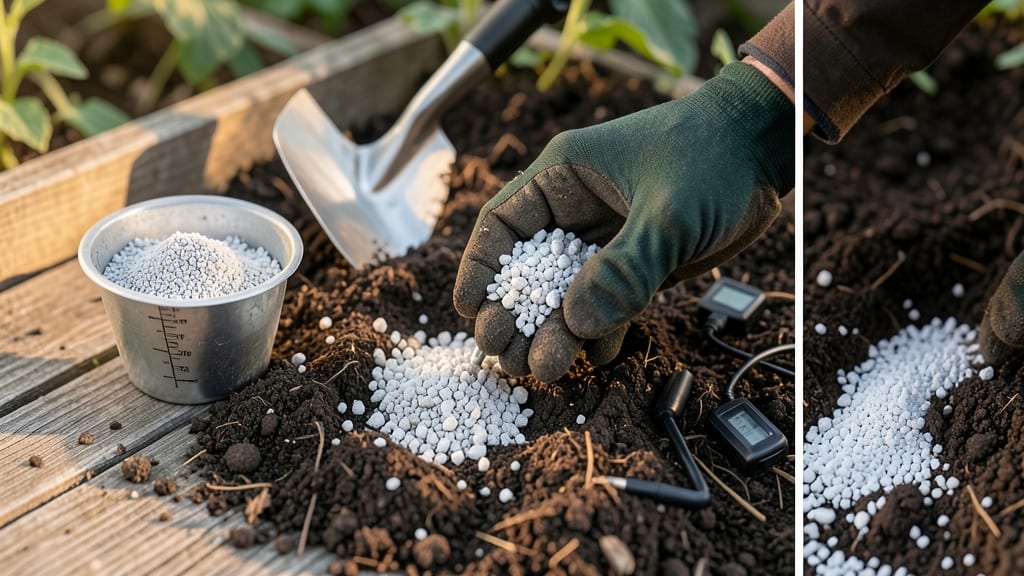
To determine how much perlite to add to garden soil, use 20-30% perlite by volume for most plants—mix 1 part perlite with 3-4 parts soil. Sandy soils may need less (15-20%), while heavy clay benefits from up to 40% perlite for better aeration and drainage. Always tailor the mix to your specific soil type and plant needs.
Perlite acts like a soil sponge, creating air pockets that roots love while preventing waterlogging. 🌱 For container plants, I often start with a 25% perlite mix—this gives enough structure without overwhelming the soil.
The key is balancing drainage with moisture retention; too much perlite can dry out delicate roots, while too little leaves soil compacted and suffocating. Always test your mix by squeezing a handful—it should crumble easily but hold its shape.
For heavy clay soils, I’ve found that mixing in 35-40% perlite works wonders, breaking up the dense texture and encouraging better root penetration. On the flip side, sandy soils already drain too quickly, so I reduce perlite to 10-15% and focus on adding organic matter like compost instead.
The goal is to mimic ideal loamy soil conditions where roots can breathe and access nutrients efficiently.
💡 In This Article
- How Perlite Improves Soil Structure and Plant Health
- Perlite Mixing Ratios for Specific Plants and Soils
How perlite improves soil structure and plant health
Perlite’s magic lies in its microscopic, glass-like bubbles created when volcanic rock expands at 1,600°F during heating. These bubbles give perlite a porous structure with a surface area of about 300-400 square meters per gram, creating tiny air pockets that improve soil aeration.
When mixed into garden soil, these air pockets replace compacted spaces, allowing roots to breathe and access oxygen—a critical factor for root growth and microbial activity.
The porous nature also regulates moisture by absorbing and releasing water like a sponge. In heavy clay soils, perlite’s 90-95% air-filled pores prevent waterlogging by creating drainage channels, while in sandy soils, it helps retain moisture longer.
This dual function explains why perlite works across soil types: it mimics the ideal 45% solids, 25% water, and 30% air ratio found in healthy garden soil. 🌱 Without perlite, clay soils can suffocate roots by holding too much water, while sandy soils lose nutrients too quickly.
For plant health, these improvements translate directly to stronger root systems. Studies show that perlite-amended soils can increase root mass by 20-30% in container plants because roots don’t have to fight for oxygen.
The lightweight nature also prevents soil compaction during watering or foot traffic, keeping pathways open for both water and nutrients. Even delicate plants like orchids benefit from perlite’s sterile, pH-neutral properties, which prevent fungal issues common in dense soils.
However, the benefits depend on proper mixing. Simply scattering perlite on top won’t work—it needs to be thoroughly incorporated to create uniform air pockets.
For example, a 25% perlite mix in container soil creates about 15% more pore space than unamended soil, while a 40% mix can double aeration in heavy clay. The key is balance: too much perlite (over 50%) can dry out soil, while too little leaves compaction issues unresolved.
Consider this comparison: Sandy soil without perlite drains water in 1-2 hours, while the same soil with 20% perlite retains moisture 3-4 times longer. Clay soil without perlite may stay waterlogged for days, but with 35% perlite, excess water drains within 6-8 hours.
These time differences highlight perlite’s role in creating an optimal growing environment where plants can thrive without stress.
One often-overlooked benefit is perlite’s ability to buffer soil temperature fluctuations. The air pockets act as natural insulation, keeping root zones 5-10°F cooler in summer and 3-5°F warmer in winter compared to dense soils.
This temperature stability is particularly valuable for heat-sensitive plants like lettuce or cold-hardy perennials that struggle with extreme ground temperatures.
For gardeners, this means healthier plants with less risk of root rot or nutrient deficiencies. The science behind perlite’s effectiveness lies in its ability to simultaneously address three critical soil factors: aeration, drainage, and moisture retention—all while remaining chemically inert and long-lasting in the garden. 💫