
Tools
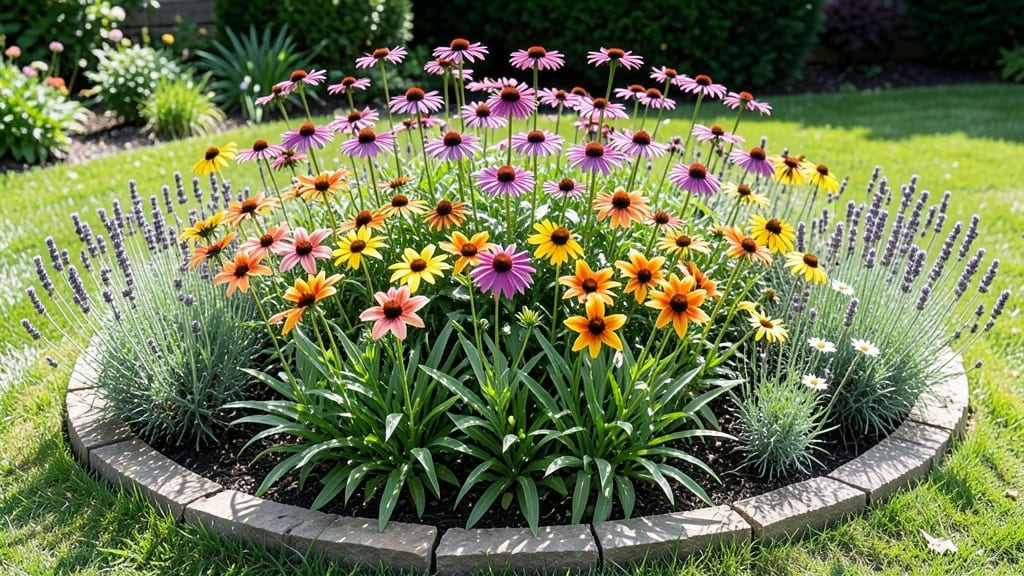
A flower garden in the shape of a circle creates natural symmetry and visual balance by centering focal points like a fountain, bench, or large tree while using concentric planting beds or radial pathways for cohesion. Key principles include even spacing, repeating plant varieties, and soft transitions between colors for a seamless look.
A flower garden in the shape of a circle isn't just pretty—it's a masterclass in visual harmony. 🌸 The secret lies in how layers work together: taller plants like ornamental grasses or shrubs anchor the center, while mid-height flowers create the "ring" effect, and low-growing ground covers fill gaps.
Think of it like a well-composed painting where every element has its place. I've found that using odd-numbered groupings (like 3 or 5 of the same plant) creates more dynamic movement than even numbers, which can look too rigid.
For the perfect balance, start with your largest feature—whether it's a statue or a tree—and build outward from there.
💡 In This Article
- Designing a Circular Flower Garden for Optimal Visual Flow
- Best Plant Choices for Low-Maintenance Circular Gardens
Designing a circular flower garden for optimal visual flow
The circular shape works because it naturally directs the eye in a continuous loop, creating a sense of movement and rhythm. At its core, this design relies on radial symmetry, where elements radiate outward from a central point.
Imagine a pie cut into equal slices—each slice should mirror its neighbors in plant selection and height progression.
For instance, a 12-foot diameter garden might feature a central fountain surrounded by three concentric rings: the first ring with 3-foot-tall shrubs, the second with 2-foot perennials, and the outer ring with 1-foot ground covers.
This gradient prevents visual clutter and ensures every layer contributes to the overall harmony. 🌿
Color theory plays a crucial role in maintaining cohesion. Professional gardeners often use the 60-30-10 rule for circular gardens: 60% dominant colors (like soft blues or purples), 30% secondary hues (warm yellows or pinks), and 10% bold accents (deep reds or oranges).
For example, a lavender-blue theme might feature Russian sage as the dominant plant, catmint as the secondary, and red salvia as the accent. This approach creates visual breathing room while keeping the design vibrant.
The key is to place accent plants in odd-numbered clusters—like three red salvia near the center—to avoid symmetry fatigue. 🎨
Pathways are another critical element that enhances visual flow. Radial paths (like spokes on a wheel) draw attention to the center, while concentric paths (circular rings) encourage exploration. For a 15-foot garden, a 2-foot-wide gravel path spiraling outward creates natural separation between plant layers.
The material matters too: light-colored gravel reflects sunlight, making the garden appear larger, while dark mulch adds contrast. I've seen stunning results using stepping stones placed every 3 feet along radial paths to guide foot traffic without disrupting the natural flow. 🌟
Lighting transforms a circular garden after dark. Strategically placed solar-powered path lights (every 4 feet) along the outer edge create a glowing halo effect, while uplights angled toward the center highlight focal points.
Warm white bulbs (2700K) cast a cozy glow, while cool white (4000K) enhances contrast. For a 20-foot garden, I recommend placing two spotlights near the center to illuminate key features like a statue or tree.
This not only enhances safety but also extends the garden's usability into the evening hours. 💡
Modern circular gardens often break from strict symmetry by incorporating organic shapes or asymmetrical elements. For example, a free-form curve in the outer border can soften the geometric precision, while varying plant heights (like 2-foot vs 2.5-foot shrubs) add depth.
This approach works particularly well in cottage-style gardens where rustic charm is the goal. The key is to maintain balance—if one side has a taller plant, compensate with a wider planting bed on the opposite side. This technique ensures the eye never feels pulled in one direction. 🌸
Seasonal transitions are where circular gardens truly shine. By layering plants with staggered bloom times—like spring bulbs, summer perennials, and fall mums—you create a year-round visual feast.
For a 10-foot garden, I recommend planting daffodils in the center (spring), coneflowers in the middle ring (summer), and heuchera in the outer ring (fall/winter interest). This progression ensures the garden remains dynamic and never feels static. 🌼