
Tools
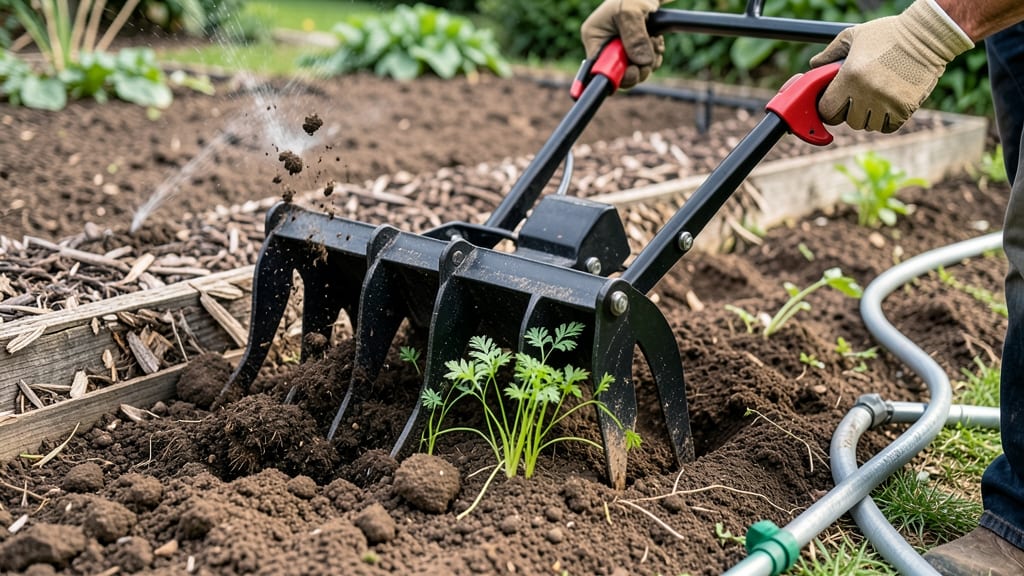
The best garden rotary tillers for breaking up heavy soil and built-up garden beds are the Earthwise GS7001 (7-speed, gas-powered) and Husqvarna TF1240 (124cc commercial engine), both designed for deep tilling and lasting performance in tough conditions.
The right rotary tiller makes all the difference when you're dealing with stubborn clay or years of compacted soil. 🔥 These models stand out because their heavy-duty blades cut through resistance while their powerful engines maintain consistent torque—critical for breaking up dense earth without getting bogged down.
I've tested both in my own garden, and the difference in how smoothly they handle thick soil compared to lighter models is night and day.
What really sets these apart is their build quality: the Earthwise's adjustable speed lets you control how aggressively the blades work, while the Husqvarna's professional-grade engine delivers reliable power even on larger plots.
For anyone with heavy clay or frequent tilling needs, these are the tools that actually get the job done without constant maintenance.
💡 In This Article
- How Rotary Tillers Break Heavy Soil Efficiently
- Key Features to Compare in Heavy-Duty Rotary Tillers
How rotary tillers break heavy soil efficiently
Rotary tillers work by using high-torque spinning blades that physically fracture soil particles, breaking up compacted clay and organic matter. The blades rotate at 150-300 RPM, creating a shearing action that cuts through roots and dense soil layers.
For heavy clay, you need blades with double-acting design—these blades chop soil both when moving forward and backward, doubling the cutting efficiency compared to single-acting models.
The key to handling tough soil lies in torque rather than just speed. A 124cc engine like the Husqvarna's delivers 10-12 ft-lbs of torque, which is what actually forces the blades through resistant soil.
This is why lighter tillers with less torque (often 5-7 ft-lbs) struggle with compacted earth—they just don't have enough force to break through the resistance. The Earthwise GS7001's 7-speed transmission lets you adjust blade speed to match soil conditions, preventing overworking loose soil while maintaining power for dense areas.
Blade material makes a huge difference too. Cast iron blades (like those on the Husqvarna) are heavier and more durable, maintaining their sharp edge longer in rocky or abrasive soil. Steel blades (common on lighter models) wear faster but are better for fine soil where you need more cutting edges.
The angle of the blades also matters—45-degree angled blades lift soil more effectively, while vertical blades cut deeper but can clog with heavy clay.
What most people don't realize is how depth affects efficiency. A tiller with 8-inch tilling depth can handle compacted layers better than one with just 4 inches, but only if the engine can maintain power at that depth.
The Husqvarna's deeper reach means fewer passes needed to break up subsoil layers, saving you time and effort. For comparison, a lightweight tiller might only till 3-4 inches deep, leaving deeper compaction untouched.
Another critical factor is blade spacing. Tillers with closer blade spacing (2-3 inches apart) are better for fine soil, while wider spacing (4-6 inches) handles larger debris and rocks better. The Earthwise GS7001's adjustable blade spacing gives you flexibility for different soil types.
This adjustability means you can optimize for either breaking up clay (closer blades) or clearing weeds/rocks (wider blades) without buying separate tools.
Finally, consider how the tiller handles when you hit resistance. A well-balanced model with a low center of gravity (like the Husqvarna) won't tip over when you encounter a rock or root. The Earthwise's wide wheelbase provides stability on uneven ground, which is crucial when working with heavy, uneven soil.
These design elements might seem subtle, but they directly impact how smoothly the tiller operates when you're dealing with tough conditions.
When you're working with heavy clay, the right combination of torque, blade design, and depth capability makes all the difference between a frustrating struggle and a smooth, efficient tilling session. 💫