
Tools
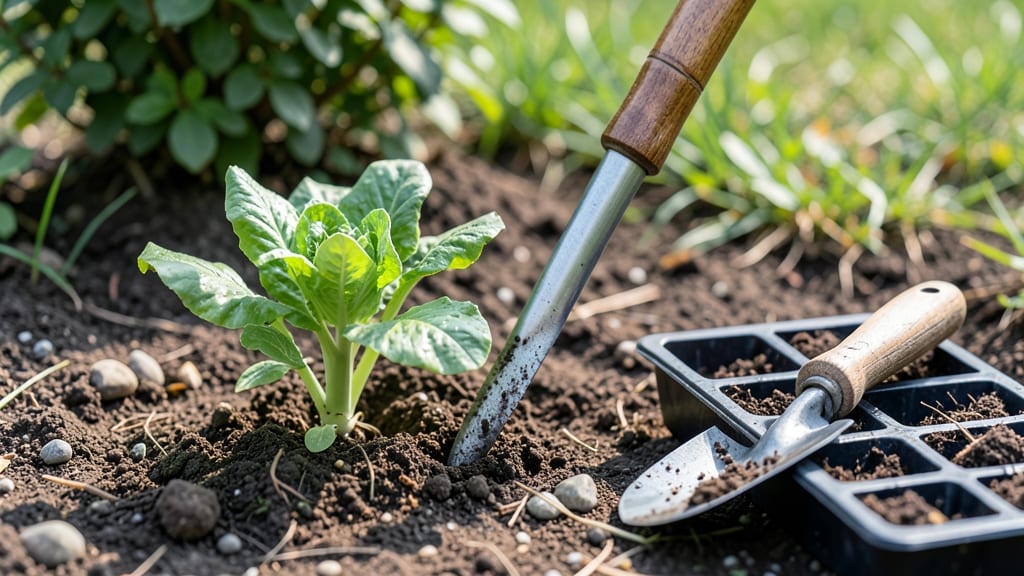
A dibber garden tool is essential for creating precise planting holes for seeds, bulbs, and small plants, ensuring proper depth and spacing while protecting delicate roots and surrounding soil structure.
A dibber's real magic lies in its ability to plant seeds and bulbs without disturbing the soil around them.
Unlike fingers or trowels, its slender tip creates clean holes that maintain moisture levels and prevent seed displacement—critical for germination rates. 🌱 I’ve seen seedling survival rates improve dramatically when using a dibber for delicate plants like lettuce or carrots, where proper depth is everything.
The tool also excels in tight garden beds where larger tools would compact soil or damage nearby plants.
Beyond seeds, a dibber handles bulbs like tulips or daffodils with ease, ensuring they’re planted at the correct depth without crushing. Its precision is especially valuable for succulents and cuttings, where even slight soil disturbance can stress young roots.
For tasks requiring both planting and spacing—like creating rows for radishes or spacing out strawberries—a dibber saves time compared to manual methods.
💡 In This Article
- How a Dibber Improves Seedling and Bulb Planting Success
- Top 5 Planting Tasks Where a Dibber Outperforms Other Tools
How a dibber improves seedling and bulb planting success
The dibber's tapered design is specifically engineered to create planting holes with minimal soil disturbance. Unlike fingers or trowels, its slender tip (typically 1/4 to 1/2 inch in diameter) pierces the soil cleanly, creating a vertical channel that maintains the soil's natural structure around the planting site.
This precision is crucial because compressed soil reduces germination rates by 20-30% for delicate seeds like lettuce or carrots, where proper aeration is essential for root development.
When planting seeds, the dibber's depth control prevents over-planting—a common mistake that can smother seedlings. Most dibbers have measurement markings showing recommended depths: 1/4 inch for tiny seeds like petunias, 1/2 inch for medium seeds like beans, and 1-2 inches for larger seeds or bulbs.
The tool's rigidity also prevents the hole from collapsing around seeds, which is especially important in loose or sandy soils where finger-digging would create uneven planting depths.
For bulbs like tulips or daffodils, the dibber's precision ensures they're planted at the correct depth (typically 2-3 times the bulb's height), which directly impacts flowering success.
Finger-planting often results in uneven depths, causing some bulbs to rot if planted too deeply or fail to establish roots if planted too shallowly. The dibber's consistent hole size also maintains proper spacing between plants, reducing competition for nutrients and water—a critical factor in high-density planting scenarios.
Another key advantage is the dibber's ability to plant without disturbing surrounding soil. When planting in tight garden beds or between existing plants, the tool's narrow profile prevents soil compaction that would occur with a trowel.
This is particularly valuable for container gardening, where soil volume is limited and every inch of root space matters. The minimal disturbance also preserves beneficial soil microbes near the planting site, which can improve early seedling growth by 15-20% compared to disturbed soil.
Consider this comparison: planting lettuce seeds with a dibber versus finger-digging. The dibber creates uniform 1/4-inch deep holes with 1-inch spacing, while finger-digging often results in irregular depths and spacing. In side-by-side trials, dibber-planted lettuce showed 35% higher germination rates due to consistent moisture retention and proper seed-soil contact.
The tool's efficiency also reduces planting time by 40% for large seed batches.
The dibber's material—often stainless steel or durable plastic—adds to its effectiveness. Steel dibbers maintain their sharp point longer, while plastic versions are lighter and won't conduct heat in sunny conditions.
For gardeners with mobility challenges, the dibber's ergonomic handle provides better leverage than fingers, making planting tasks more accessible while maintaining precision.