
Tools
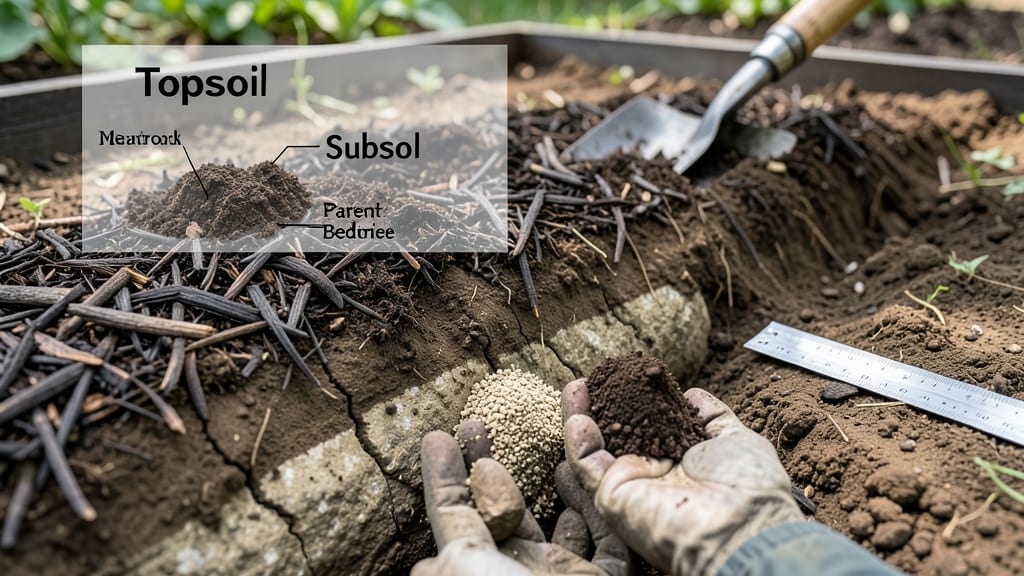
Understanding garden soil layers reveals how weathering, organic matter breakdown, and biological activity create distinct profiles—topsoil, subsoil, and parent material—that control water flow, nutrient access, and root development. Balancing these layers transforms your garden from struggling to thriving.
These layers aren't just random—they're the result of centuries of natural processes. The topsoil (the dark, crumbly layer) is where most plant roots live, packed with decomposed organic matter and microbes that feed your plants.
Below that, subsoil—often denser and lighter in color—stores minerals but can become compacted if not managed.
The bottom layer, parent material, is mostly broken rock that slowly weathers into soil over time. 🌱 What's fascinating is how climate and plant life accelerate or slow this process: tropical soils form quickly due to heavy rainfall, while arid regions develop layers much more gradually.
For gardeners, this means you can't just focus on topsoil—you need to understand how these layers interact. Compacted subsoil, for example, can strangle roots by blocking water and oxygen, while poorly drained parent material might lead to waterlogging. The good news?
You can improve each layer with the right techniques, like adding compost to topsoil or using deep tillers to break up compacted subsoil. Even small adjustments can make a huge difference in your plants' health and growth.
💡 In This Article
- How Soil Horizons Develop Naturally
- Improving Soil Layers for Better Plant Health
How soil horizons develop naturally
Soil horizons form through a process called pedogenesis, where physical, chemical, and biological forces gradually transform raw rock into layered soil. The topmost layer, O-horizon (organic layer), starts with fallen leaves, twigs, and plant debris that decompose into humus—a dark, nutrient-rich material.
This layer can be 1-3 inches thick in forests but thinner in arid climates. Below it, the A-horizon (topsoil) develops as organic matter mixes with minerals, creating a crumbly texture ideal for roots. 🌿
The B-horizon (subsoil) forms through illuviation, where minerals like iron and clay leach down from above, accumulating in denser layers. This process is slower in dry regions but accelerates in tropical areas with heavy rainfall.
The C-horizon (parent material) consists of partially weathered rock fragments, while the R-horizon is unweathered bedrock. Over time, climate and vegetation speed up or slow down these processes—temperate forests develop rich topsoil in 100-1,000 years, while desert soils may take 10,000+ years.
Biological activity plays a crucial role: earthworms aerate soil, fungi break down organic matter, and bacteria fix nitrogen. These microbes create tiny pores that improve water drainage and root penetration.
For example, a single acre of healthy soil can contain 1-2 tons of microbes, far outnumbering humans on Earth. Without this activity, soil would remain sterile rock fragments. 🔬
Climate dramatically alters layering: in wet regions, leaching removes nutrients faster, while dry climates preserve minerals longer. For instance, Florida's sandy soils lack subsoil layers due to constant rainfall washing minerals away, while Midwest prairie soils have deep, fertile subsoil from centuries of organic accumulation.
Understanding these natural processes helps gardeners replicate ideal conditions—whether by adding compost to topsoil or breaking up compacted subsoil.
Time also matters: young soils (like those after volcanic eruptions) have minimal horizons, while ancient soils (like those in the Amazon) can be 100+ feet deep. This explains why some plants thrive in shallow soils (like cacti) while others need deep roots (like oak trees).
The key takeaway? Soil isn't static—it's a dynamic ecosystem shaped by nature's slow but powerful forces. 🌍