
Light Requirements
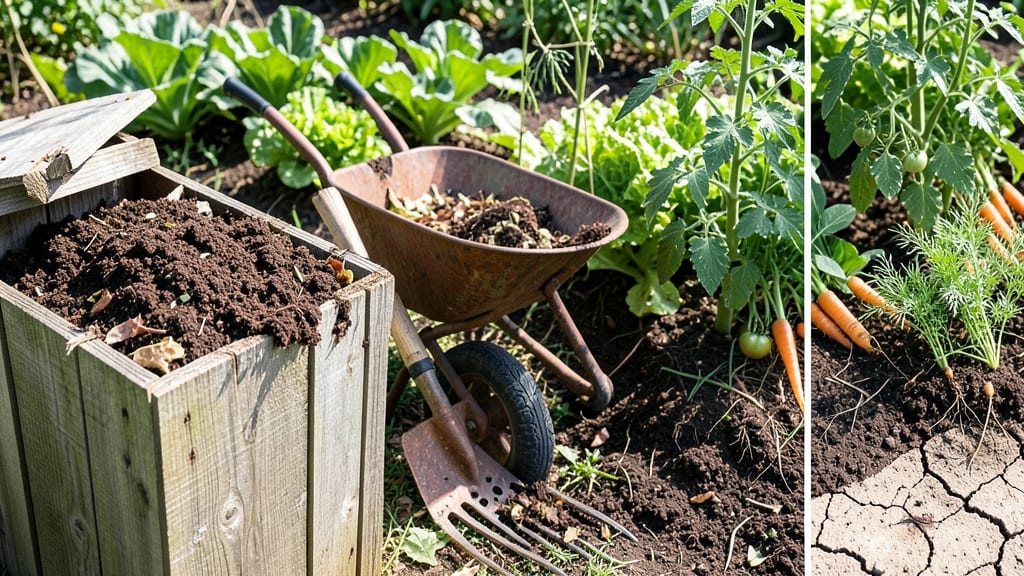
To determine how much compost you need for your garden, calculate 1–3 inches spread across the top 6–12 inches of soil for vegetables, 1 inch for lawns, and 25–50% compost in potting mixes. Always test your soil first to prevent over-amending.
Compost needs vary dramatically based on your garden's purpose.
For vegetable gardens, where nutrient demands are highest, aim for the upper end of the range—3 inches—to support heavy feeders like tomatoes and peppers. Ornamental plants and lawns need less, but even here, a 1-inch layer improves soil structure and microbial activity. 🌱 The key is balancing organic matter: too little leaves soil compacted and nutrient-poor, while too much can suffocate roots by reducing oxygen flow.
I always start with a soil test to check pH and existing organic content before adding compost.
For container gardens, where space is limited, focus on the mix ratio rather than volume. A 50% compost blend with potting soil gives roots the ideal balance of aeration and moisture retention.
In raised beds, spread compost evenly and lightly till it into the top 6 inches—this prevents clumping while ensuring even distribution. Remember, compost is best applied as a top-dressing in spring or fall, letting it gradually integrate with your soil.
💡 In This Article
- Calculating Compost Needs by Garden Type and Soil Conditions
- Step-by-Step Guide: Applying Compost to Beds and Containers
Calculating compost needs by garden type and soil conditions
Your garden's soil type dictates how much compost you'll need. Clay soils, which compact easily and drain poorly, benefit from 3-4 inches of compost to improve aeration and water retention. Sandy soils, on the other hand, need 2-3 inches to help retain nutrients and moisture.
The goal is to increase your soil's organic matter content to 5-10%—this level enhances microbial activity, which breaks down nutrients into plant-available forms. 🌱 For example, a 10x10-foot vegetable bed with clay soil would need about 3 cubic feet of compost (or roughly 10 gallons) spread evenly across the surface.
Vegetable gardens demand the most attention because they're heavy feeders. Plants like tomatoes, squash, and corn require 3 inches of compost worked into the top 12 inches of soil, while leafy greens like lettuce and spinach do well with 1-2 inches.
Ornamental plants and perennials need less—typically 1 inch—but spreading it annually maintains soil health. The key difference lies in nutrient cycling: vegetables deplete soil faster, so they need more frequent amendments.
For lawns, a ½-inch layer spread over the entire area in spring and fall suffices, though high-traffic areas may need up to 1 inch.
Container gardens operate on a different scale entirely. Since space is limited, focus on the mix ratio rather than volume. A 50% compost blend with potting soil creates an ideal growing medium that retains moisture while preventing compaction.
For a 5-gallon container, that means about 2.5 gallons of compost mixed with 2.5 gallons of potting soil. The compost provides essential microbes and nutrients, while the potting soil ensures proper drainage.
In raised beds, spread 1-2 inches of compost and lightly till it into the top 6 inches—this prevents clumping while ensuring even distribution across the root zone.
Soil testing reveals critical insights before you even buy compost. A simple pH test (available at garden centers) tells you whether your soil is acidic, alkaline, or neutral—compost helps buffer extremes.
For instance, if your soil tests at pH 6.5 or lower, adding compost raises the pH slightly, improving nutrient availability. Organic matter also affects water retention: sandy soils with 1% organic matter hold 10% less water than soils with 5% organic matter.
This is why compost is a game-changer for drought-prone gardens. 💧
Over-amending is a common mistake that can harm your garden. Too much compost—especially fresh, undecomposed material—can create an anaerobic environment, suffocating roots by blocking oxygen flow.
A good rule of thumb is to never exceed 50% compost in any mix, and always work it into the soil rather than piling it on top.
For example, if your soil test shows 3% organic matter, aim to increase it by 1-2% per year rather than doubling it overnight. Patience pays off in healthier plants and long-term soil fertility.
Consider these key factors when choosing compost for your garden:
- Decomposition level: Fully decomposed compost (dark, crumbly, and earthy-smelling) is ideal for most plants. Partially decomposed compost works well for top-dressing lawns or mulching.
- Nutrient content: Look for compost with a 1:1 carbon-to-nitrogen ratio (or slightly higher in carbon) to avoid nitrogen burnout, which can scorch plants.
- Texture: Fine, sifted compost blends easily into soil, while chunkier compost is better for mulching or improving drainage in heavy soils.