
Light Requirements
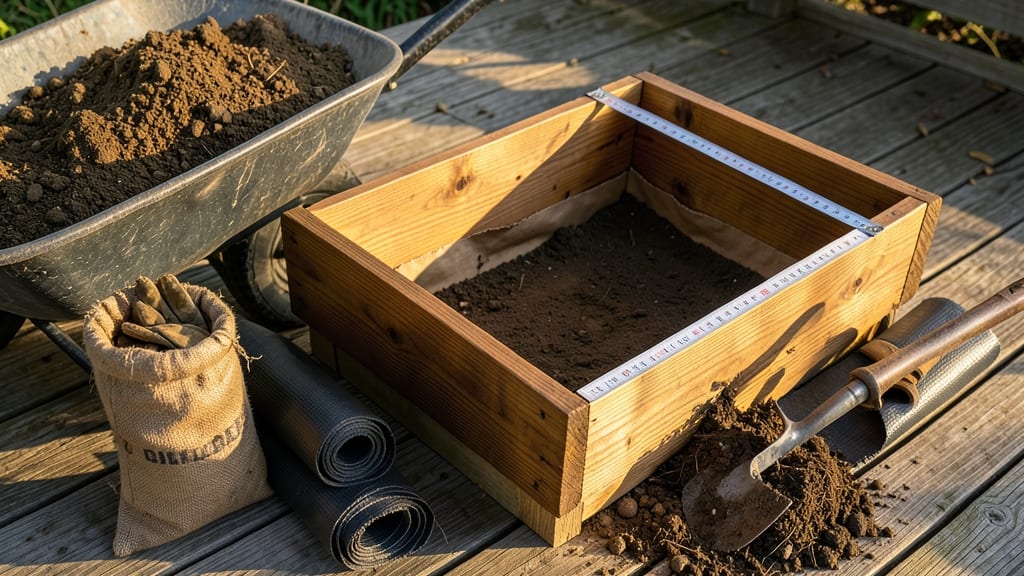
To determine how much dirt for a raised garden bed, calculate cubic feet by multiplying length × width × depth (in feet), then convert to cubic yards (1 cubic yard = 27 cubic feet). A standard 4’×8’×12” bed requires about 3.2 cubic yards of quality soil mix for healthy plant growth.
Calculating the right amount of soil ensures your plants thrive without waste. The key is balancing depth—most vegetables need 10–12 inches of soil, while shallow-rooted herbs can do well with 6 inches.
For example, a 4’×4’ bed at 12” depth needs roughly 1.3 cubic yards, while a larger 8’×4’ bed jumps to 2.7 cubic yards. 🌱 I always recommend buying 10% more than calculated to account for settling and uneven bed bases.
Don’t forget that soil type matters just as much as quantity. Heavy clay soils drain poorly, while sandy mixes lose nutrients quickly. A balanced mix—typically 60% topsoil, 30% compost, and 10% perlite—works best for most vegetables.
For flowers, you might increase the compost ratio to 40% for better blooms. Always test your soil’s drainage before filling the bed to avoid root rot.
💡 In This Article
- Calculating Soil Volume for Raised Beds by Size
- Best Soil Mixes for Raised Garden Beds by Plant Type
Calculating soil volume for raised beds by size
Understanding soil volume starts with converting your raised bed's dimensions into cubic feet, then scaling up to cubic yards. Here's what's actually happening: when you multiply length × width × depth (all in feet), you're calculating the total space your soil will occupy.
For example, a 4’×8’ bed with 12” depth (1 foot) needs 32 cubic feet of soil. Since most suppliers sell by cubic yards (1 cubic yard = 27 cubic feet), you'd divide 32 by 27 to get 1.18 cubic yards—round up to 1.2 cubic yards for practicality.
The depth matters more than you might think. Most vegetables thrive with 10–12 inches of soil, while herbs like thyme or oregano can do well with just 6 inches. This is because deeper beds allow roots to access more nutrients and water, especially during dry spells.
A 4’×4’ bed at 12” depth gives you 1.3 cubic yards, while the same bed at 6” depth drops to 0.67 cubic yards. The difference in soil quantity might seem small, but it directly impacts your plant's ability to establish strong root systems and withstand environmental stress.
What most people don't realize is how much soil settles over time. Freshly filled beds can lose 10–20% of volume within the first few weeks as organic matter breaks down and compacts.
This is why I always recommend buying 10–15% more than your calculation—it's better to have extra than struggle with a shallow bed mid-season. For instance, if your math says 2.5 cubic yards for an 8’×4’ bed, order 2.9 cubic yards instead.
The extra soil also comes in handy for top-dressing later in the growing season.
Consider these common bed sizes and their soil requirements:
- 4’×4’ bed at 12” depth: 1.3 cubic yards (round to 1.5 cubic yards)
- 4’×8’ bed at 12” depth: 3.2 cubic yards (standard for most home gardens)
- 8’×4’ bed at 12” depth: 3.2 cubic yards (same as above—orientation doesn't change volume)
- 6’×6’ bed at 10” depth: 3.0 cubic yards (round to 3.3 cubic yards)
For larger projects, like commercial-scale beds or community gardens, you might need to rent a dump truck. A typical 10-yard dump truck can handle about 3–4 standard 4’×8’ beds filled to 12” depth, making it cost-effective for bulk orders.
Always verify with your supplier about delivery fees—some charge per cubic yard, while others have flat rates for larger quantities.
Pro tip: Measure your bed's interior dimensions—not the outer frame—since the wood will take up some space. For example, a 4’×8’ frame might actually give you a 3’6”×7’6” planting area after accounting for board thickness.
This small difference can affect your soil calculation by up to 10% in smaller beds. 🌱