
Light Requirements
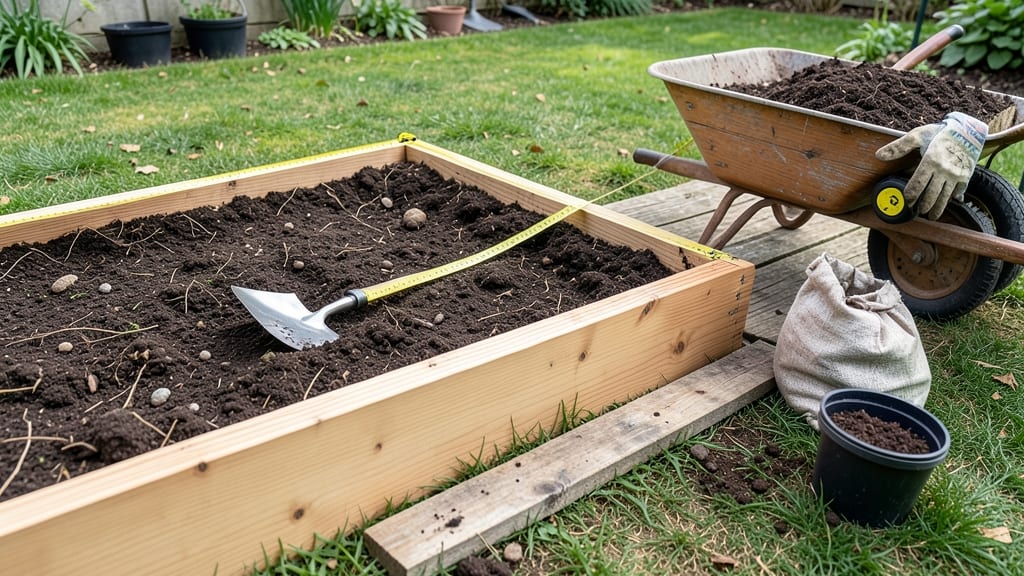
To determine how much soil for a garden bed, multiply its length by width by depth (in feet) to get cubic feet—e.g., a 4’x8’ bed at 12” depth needs 32 cubic feet of soil. Adjust for existing soil quality and plant root depth requirements.
Calculating the right amount of soil for your garden bed starts with precise measurements. 🌱 The formula works because garden beds aren't flat surfaces—they have depth, and that vertical space determines how much soil you'll need to fill completely.
For example, a 6-foot by 3-foot bed with 6 inches of depth requires 9 cubic feet of soil, but if you double the depth to 12 inches, you'll need twice as much.
Always account for the type of soil too: loose topsoil settles differently than dense compost mixes, which can affect your final volume by up to 20%.
Beyond the math, consider your plants' needs. Root crops like carrots need at least 12 inches of soil depth to grow properly, while shallow-rooted herbs might only require 6 inches. If your existing soil is poor, you may need to blend in 30-50% compost to improve drainage and fertility.
This adjustment isn't just about volume—it's about creating the ideal growing environment for your plants to thrive.
💡 In This Article
- Calculating Soil Volume for Garden Beds by Depth and Size
- Choosing the Right Soil Type and Amendments for Your Garden Bed
Calculating soil volume for garden beds by depth and size
The cubic feet formula works because garden soil volume combines three critical dimensions: length × width × depth. For example, a 4-foot by 8-foot bed with 12 inches (1 foot) of depth requires 32 cubic feet of soil (4 × 8 × 1).
The key is converting all measurements to feet—since 12 inches equals 1 foot, this avoids decimal confusion. If your depth is 6 inches, convert it to 0.5 feet first, then multiply.
Accuracy matters because soil settles differently based on texture. Loose topsoil may compact by 15-25% after watering, while dense clay settles only 5-10%. A 10-foot by 10-foot bed at 12 inches deep needs 100 cubic feet fresh, but after settling, you might need 120 cubic feet to account for compression.
Always measure the final depth you want—roots need space to grow downward, not just sideways.
Depth directly impacts plant health. Shallow beds (6 inches) work for herbs but stunt root crops like potatoes. A 12-inch depth is ideal for most vegetables, while fruit trees need 24+ inches. The extra volume isn’t just about space—it improves drainage and prevents waterlogging.
For example, a 3-foot by 6-foot bed at 18 inches deep requires 27 cubic feet, but adding 6 more inches jumps to 36 cubic feet—a 33% increase for better root development.
Existing soil quality affects your calculations too. If your native soil is rocky or compacted, you may need 30-50% more soil to create a proper growing medium.
For instance, a 5-foot by 5-foot bed at 12 inches deep needs 25 cubic feet of topsoil, but if you’re replacing poor soil entirely, buy 35-40 cubic feet to account for mixing ratios.
Always test your soil first—pH and texture determine how much compost or sand you’ll need to blend in.
Pro tip: Buy soil in 1-cubic-foot bags (about 40 pounds each). For a 40-cubic-foot bed, you’d need 40 bags. But if using bulk deliveries, confirm the truck’s cubic yard capacity—1 cubic yard = 27 cubic feet.
A 30-cubic-foot bed fits in 1.1 cubic yards, while 50 cubic feet requires 1.85 cubic yards. Always round up—underestimating means extra trips, and overestimating wastes money.
Visualize your bed’s shape too. Rectangular beds are straightforward, but raised beds with sloped sides or curved edges need extra soil. For example, a 4-foot diameter circular bed with 12-inch sides holds about 18 cubic feet (πr²h).
Always add 10% extra for uneven edges or future expansion. The goal is to fill the space completely—roots won’t grow where soil is missing.