
Propagation
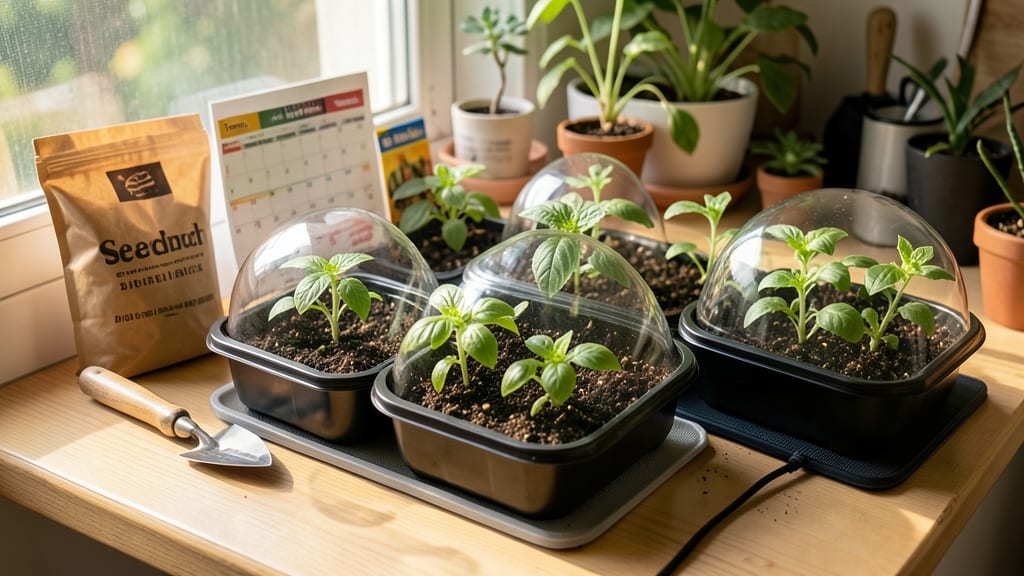
To start seeds for a spring garden, begin cool-season plants like lettuce 6-8 weeks before your last frost date, while warm-season vegetables such as tomatoes need a 4-6 week head start. Always verify your local frost dates for accurate timing.
Timing your seed starts correctly is the difference between a thriving spring harvest and wasted effort.
Cool-season crops like spinach and peas can handle early starts because they mature quickly, while warm-season plants like peppers and eggplants need longer growing seasons to produce fruit. 🌱 I’ve found that using a seed-starting calculator based on your USDA hardiness zone eliminates guesswork—just plug in your last frost date and the days to maturity for your chosen variety.
For example, basil typically needs 10-12 weeks indoors before transplanting, so if your frost date is April 15, you’d start seeds around January 15.
Don’t overlook microclimates—areas near bodies of water or south-facing walls may have 2-3 weeks earlier frost dates than official records. Test soil temperatures too: most seeds won’t sprout below 60°F.
A heat mat can give you a 2-3 week head start on slow germinators like parsley or dill, which often take 14-21 days to appear.
💡 In This Article
- How to Calculate Seed Starting Time by Plant Type
- Spring Seed Starting Checklist by Region
How to calculate seed starting time by plant type
The core principle behind seed starting is understanding each plant's days-to-maturity and aligning it with your local frost date. Cool-season crops like spinach or kale thrive in cooler temperatures and can often be sown directly into the garden 4-6 weeks before the last frost—these plants mature in 30-60 days.
Warm-season crops, however, need a longer growing window. Tomatoes, for instance, typically require 70-85 days from transplant to harvest, so starting them indoors 6-8 weeks before your last frost ensures they'll be ready to move outside when soil temperatures reach 60°F.
Germination speed varies dramatically between species. Fast growers like radishes or lettuce sprout in 5-10 days at 70°F, while slow starters like parsley or dill may take 14-21 days—this is why they need earlier starts. The seed packet is your best resource: it lists both days-to-germination and days-to-harvest.
For example, a 45-day basil variety needs 12 weeks indoors if your frost date is April 15, but a 60-day tomato variety would require 8 weeks indoors. The math is simple: subtract days-to-maturity from your frost date, then account for germination time.
Light exposure is another critical factor—most seedlings need 12-16 hours of light daily to prevent leggy growth. Without sufficient light, plants stretch toward their light source, becoming weak and prone to disease.
This is why grow lights are essential for indoor starts, especially in USDA Zones 3-7 where natural daylight is limited in early spring. A T5 fluorescent bulb placed 2-4 inches above seedlings provides the right spectrum for healthy growth. 🌱
Temperature also plays a role in germination timing. Most seeds germinate best at 70-75°F, but some, like peas, prefer cooler 60-65°F conditions. Using a seedling heat mat can accelerate germination by 3-5 days for slow starters.
However, be cautious: temperatures above 85°F can inhibit germination in many species. The key is maintaining consistency—fluctuations of more than 10°F can stress seedlings and delay growth.
Don’t forget about transplant shock—most seedlings need to be 4-6 weeks old before moving outdoors to develop strong root systems. Hardening off (acclimating seedlings to outdoor conditions) takes 7-10 days and involves gradually increasing exposure to wind, sun, and temperature changes.
For example, if your frost date is May 1, starting tomatoes indoors on March 1 gives you enough time for 8 weeks of growth plus 2 weeks of hardening off before transplanting on April 15.
For precision, use a seed-starting calculator—these tools account for your frost date, days-to-maturity, and germination time to generate a custom schedule. They’re especially useful for high-altitude gardens, where cooler temperatures can extend growing seasons by 2-4 weeks.
For instance, in Denver (Zone 5), you might start warm-season crops 2 weeks earlier than in Phoenix (Zone 9) to compensate for cooler nights.