
Pests
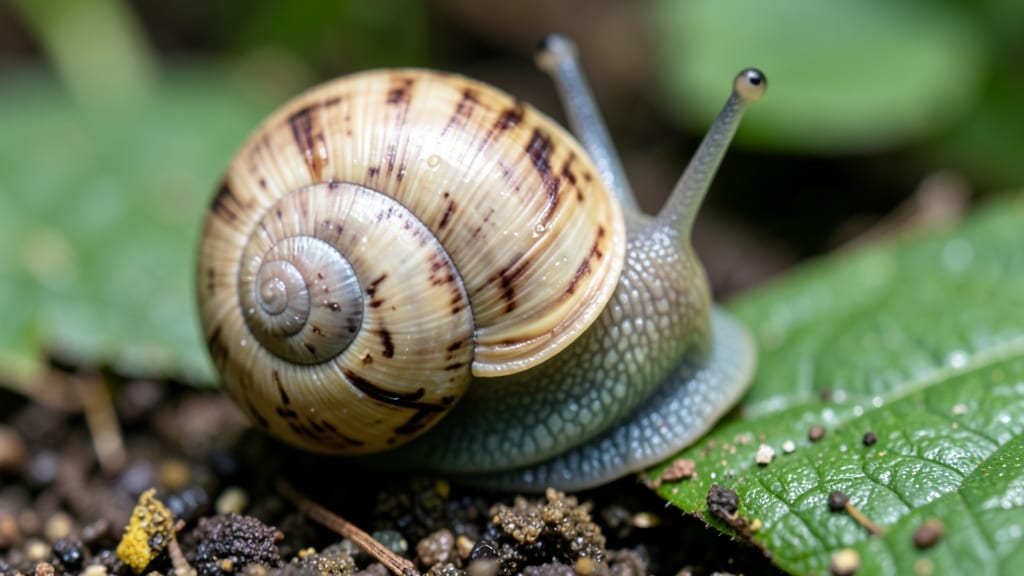
Understanding garden snail anatomy reveals how their spiral shell protects their delicate body, while their muscular foot enables gliding movement. The retractable head houses sensory antennae and a specialized radula for scraping plant matter, with a slimy mucus trail aiding both mobility and moisture retention.
Garden snails have evolved some fascinating adaptations that make them both resilient and recognizable pests. 🔥 The spiral shell isn't just for show—it acts as a portable fortress, shielding their soft bodies from predators and harsh weather.
Meanwhile, their muscular foot secretes mucus to reduce friction, allowing them to glide smoothly over surfaces while leaving behind those telltale slime trails.
What's especially interesting is how their antennae work: the longer pair detects air currents and light, while the shorter pair tests surfaces for safety before committing to movement.
These anatomical features aren't just for survival—they directly influence how snails behave in your garden. The radula, a ribbon-like structure lined with tiny teeth, lets them scrape away at leaves with remarkable precision, which is why they can cause so much damage to young plants.
And that respiratory pore? It's their breathing hole, which they must keep moist to function properly—a key reason they're often found in damp areas.
💡 In This Article
- How Garden Snails Use Their Anatomy for Survival
- Identifying Garden Snail Body Parts to Spot Pests Early
How garden snails use their anatomy for survival
The spiral shell is the snail's most iconic feature, serving as a protective retreat when threatened. This coiled structure isn't just for defense—its shape allows the snail to retract completely inside, sealing the entrance with a thick layer of mucus.
The shell's calcium carbonate composition makes it both lightweight and strong, weighing about 10-20% of the snail's total body weight. When fully extended, the shell also helps regulate body temperature by absorbing or reflecting sunlight depending on the angle. 🔥
The muscular foot is where movement magic happens, covered in tiny cilia that create waves to propel the snail forward. This foot produces 10-20 times its body weight in mucus daily, reducing friction while also serving as a waterproof barrier to prevent dehydration.
The snail's gliding speed tops out at about 0.03 mph, but this slow pace conserves energy while allowing them to traverse rough garden terrain with surprising efficiency. The foot's underside contains specialized glands that adjust mucus consistency based on surface texture.
Those two pairs of antennae are sensory powerhouses—the longer upper pair detects air currents and light levels, while the shorter lower pair tests surfaces for safety before movement. Each antenna tip contains 1,000+ sensory cells that can detect vibrations from predators up to 3 feet away.
This dual-system allows snails to navigate complex environments while avoiding threats. The antennae can also retract instantly when danger approaches, demonstrating how their anatomy integrates seamlessly with survival behaviors.
The radula is nature's precision scraping tool, a ribbon-like structure lined with 10,000-20,000 microscopic teeth that wear down over time. These teeth work like a conveyor belt, constantly regenerating as they wear from scraping plant surfaces.
A snail can consume up to half its body weight in vegetation daily, making this feeding adaptation crucial for their survival. The radula's design allows them to target specific plant parts while avoiding tough stems, explaining their preference for young, tender leaves.
The respiratory pore on the right side of their body is their breathing portal, connected to a network of lung-like tissues. This opening must stay moist to function properly, which is why snails seek damp environments.
When active, they can process about 0.5 milliliters of air per hour, a rate that increases dramatically during periods of high activity. This specialized breathing system explains why snails become dormant during dry conditions—a fascinating adaptation to their terrestrial lifestyle.
What's truly remarkable is how these anatomical features work together in harmony. The shell protects while the foot moves, the antennae sense while the radula feeds, and the respiratory pore breathes—all coordinated through a nervous system that processes environmental data in real-time.
This integrated design makes garden snails both resilient survivors and persistent garden pests. 💫