
Tools
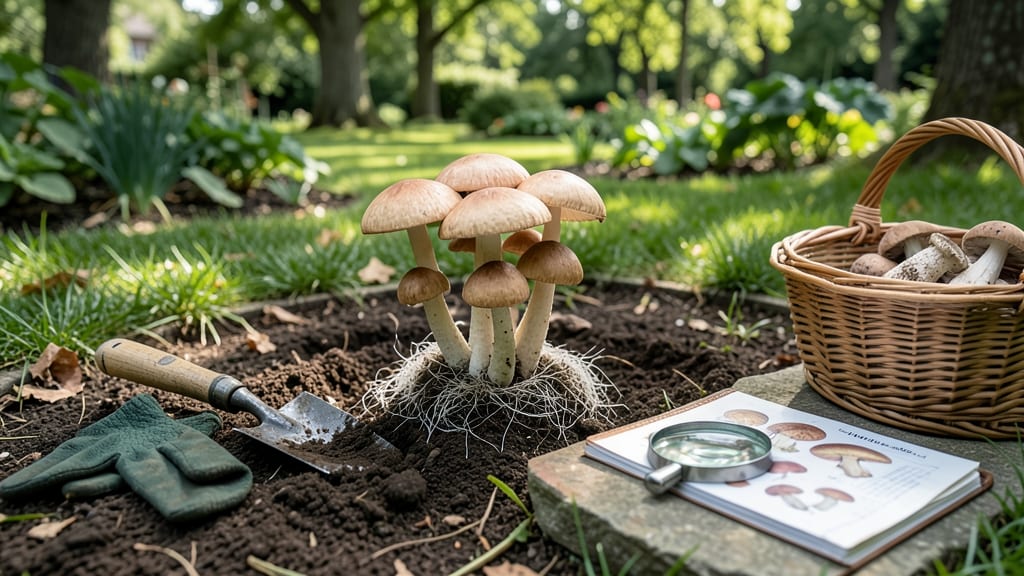
Whether you should remove mushrooms from your garden depends on their type: toxic species like death cap or destroying angel require immediate removal, while beneficial varieties such as chanterelles or morels can often be left to thrive as natural soil indicators.
Deciding whether to remove mushrooms from your garden isn't just about aesthetics—it's about safety and ecosystem balance. 🌿 Toxic mushrooms can pose serious health risks to pets and humans, especially if ingested, while others may actually improve your soil by breaking down organic matter.
I recommend using a field guide or mushroom identification app to distinguish between species before taking action. For edible varieties, consider harvesting them instead of removing them entirely.
If you choose to eliminate unwanted mushrooms, avoid chemical fungicides, which can disrupt your garden's natural balance. Instead, try physical removal with a trowel or rake, followed by covering the area with mulch or compost.
This approach not only removes the mushrooms but also enriches your soil. For persistent fungal growth, consider improving drainage or adjusting soil pH, as these factors often contribute to mushroom proliferation.
💡 In This Article
- Identifying Toxic vs Beneficial Garden Mushrooms
- Natural Ways to Manage or Encourage Mushrooms in Your Garden
Identifying toxic vs beneficial garden mushrooms
Mushroom identification starts with understanding their physical characteristics, as some species can be deadly while others are harmless or even beneficial.
Toxic varieties like death cap (Amanita phalloides) and destroying angel (Amanita bisporigera) often feature a white gill structure, a bulbous base with a sac-like volva, and a ring on the stem.
In contrast, edible species such as chanterelles (Cantharellus) lack true gills and have a fruity, apricot-like aroma, while morels (Morchella) have a honeycomb cap structure with no gills at all.
The key to accurate identification lies in examining three critical features: the cap shape, gill structure, and spore print.
For example, the death cap's cap often starts convex and flattens over time, while chanterelles maintain a more irregular, wavy edge. 🌱 To test spores, place the cap gill-side down on white paper overnight—the resulting color can reveal species (e.g., brown for Agaricus, white for Amanita).
Apps like iNaturalist or field guides like National Audubon Society Field Guide to North American Mushrooms provide visual comparisons with high-resolution images.
Never rely on smell or taste alone—some toxic mushrooms have pleasant aromas, and tasting can be fatal. Instead, focus on microscopic features when possible, such as spore shape (elliptical vs. spherical) or cystidia (specialized cells on gills).
If you're unsure, collect a sample in a paper bag (not plastic) and consult a mycologist or local university extension office. Remember, even experienced foragers make mistakes—when in doubt, remove the mushroom and dispose of it properly.
Beneficial mushrooms like oyster mushrooms (Pleurotus ostreatus) often grow in clusters on wood and help decompose organic matter, enriching soil with nutrients. These species typically have fan-shaped caps and a mild, earthy taste.
In contrast, toxic Amanita mushrooms grow singly and may appear in fairy-ring patterns, signaling potential soil imbalances. Understanding these distinctions helps you decide whether to remove or preserve these fungi in your garden ecosystem.
Consider the season and location—some mushrooms only appear after heavy rain or in specific soil conditions. For instance, Agaricus species thrive in disturbed soil, while Lactarius (milk caps) prefer forested areas. Observing these patterns can help you predict which species might appear and plan accordingly.
If you notice sudden mushroom growth after planting, it may indicate excess moisture or organic debris—addressing these root causes can naturally reduce fungal proliferation.
For gardeners unsure about identification, a simple rule applies: when in doubt, remove it. Toxic mushrooms can harm pets, children, and wildlife, so erring on the side of caution is always wise.
Use a trowel to dig out the entire mushroom, including the root-like mycelium network beneath the soil, to prevent regrowth. This method also prevents spores from spreading to other areas of your garden.